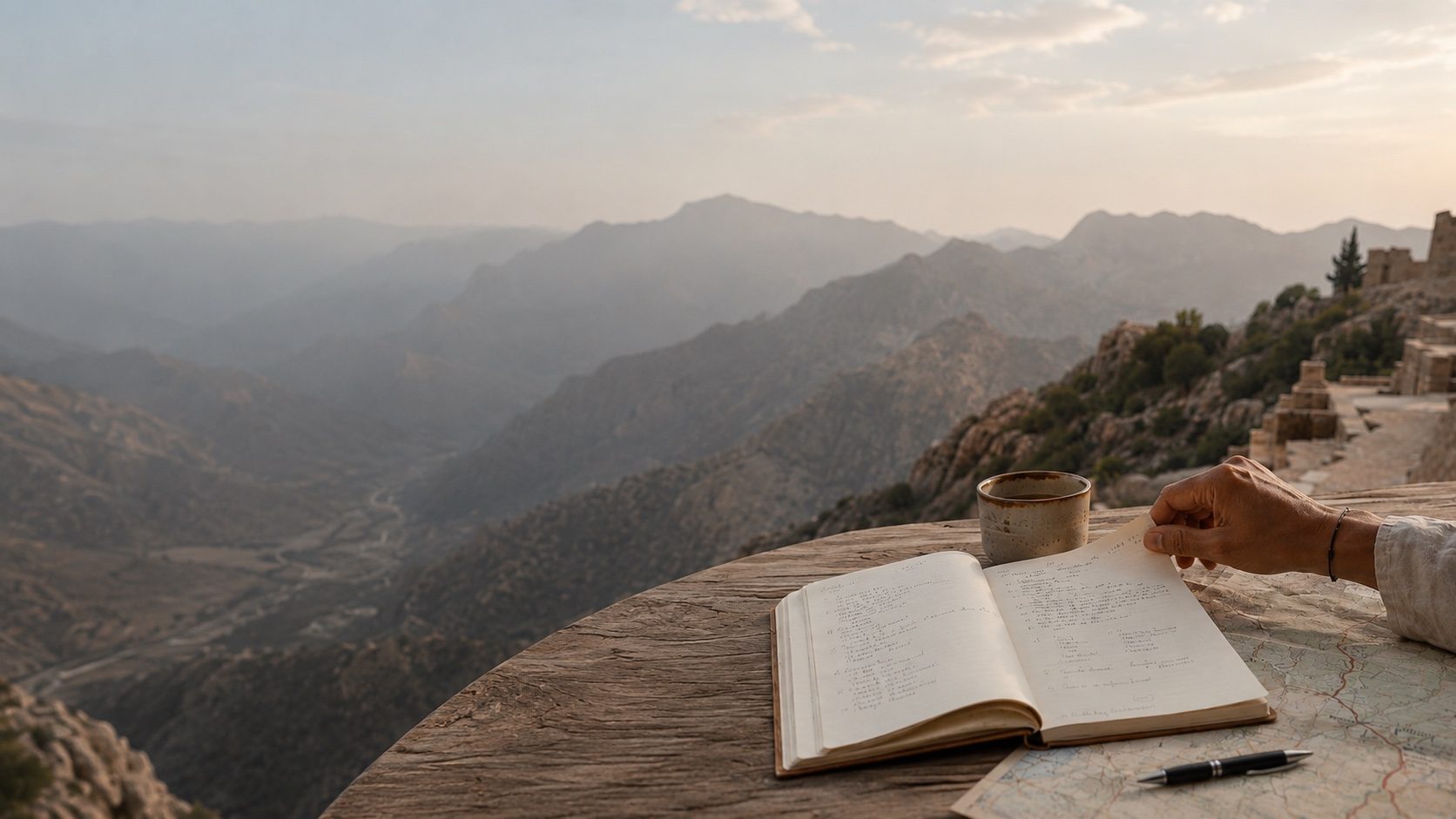
Before the map comes a conversation. Before hotels, roads and visits comes a reason to leave that is often difficult to express clearly. A traveller may arrive with a country, dates and a long list, or with tiredness, an important moment to honour, children to bring together, or the wish to stop deciding everything. Tailor-made work begins by making this material readable.
A NAWA itinerary is built through successive choices, never by ticking a request in a catalogue. It distinguishes what to protect, bring closer, simplify and sometimes remove. Its value lies as much in visible elements as in imbalances avoided — a late arrival, an attractive but remote stop, an unnecessary hotel change or a day that leaves no energy for tomorrow.
1. Before the map, the conversation
The first exchange clarifies the project as it really is. Who is travelling? When? What is already decided and what remains open? Above all, why this journey now? Answers need not be perfect. A sentence such as ‘we need to reconnect’ or ‘I want the children to see something different’ already provides a criterion for assessing options.
2. Turn intention into decisions
Intention is useful only when it changes concrete choices. Rest means fewer moves, simpler arrivals and addresses where staying feels worthwhile. Adventure needs the right level of commitment, reliable logistics and recovery. Celebration may call for one or two carefully held moments rather than continuous effects. Each intention must become pace, geography and arbitration.
3. Clarify real constraints
Budget, dates, flights, formalities, health, mobility and school calendars create the frame. Naming them early prevents a beautiful but unrealistic proposal. NAWA separates requirements from preferences and explains consequences: a direct flight may reduce fatigue but shorten the stay; scarce family rooms may guide region or season; a fixed budget may prioritise duration, location or service.
4. Define pace before adding stages
The journey’s breathing is decided before the itinerary is drawn and then guides the choice of stages. How many nights in one place? What driving time remains comfortable? When does the family function best? Is a free day reassuring or uncertain? The right pace can be active, provided it is understood and balanced.
5. Choose stages for the role they play
Each stage needs a function: opening the journey, creating contrast, offering rest, enabling an important activity or easing what follows. Two remarkable places may be incompatible if the transition is too heavy. A less celebrated stop may be essential because it balances distance or restores continuity.
6. Treat transitions as moments
A transition includes departure, transport, pauses, food and arrival. It often shapes memory more than expected. NAWA studies real schedules, road quality, drivers, ages and the days around it. When a transition is long, it needs a clear reason or a gentler design.
7. Select the right address
An address is more than a category. Location may save hours, atmosphere may help recovery, welcome may reassure a family and scale may support privacy. Sometimes a simple, well-placed hotel is more accurate than a spectacular property that compromises the route. Elsewhere, one exceptional night deserves investment because it carries an important moment.
8. Decide what must be booked
Booking everything reassures but can freeze the journey; leaving everything open transfers the mental load to the traveller. Flights, rare rooms, transport and limited-capacity experiences need anticipation. Meals, walks, half-days or weather-dependent choices may remain flexible. Freedom feels better when the main risks have already been absorbed.
9. Adjust the proposal together
The first proposal is open to discussion — it makes the project visible without deciding it. Feedback refines it, and NAWA explains chain effects: another region may require a night, removing a transfer may release budget, moving an activity may improve the rhythm. Adjustment remains a conversation rather than isolated corrections.
10. Prepare before departure
Once the structure is approved, details become practical: documents, times, contacts, luggage, clothing, money, connectivity, driving, customs and warnings. Preparation should reassure without turning the traveller into a file manager. Information is prioritised into what to do, know, postpone and who to contact.
11. A point of contact when the journey meets the unexpected
Even a carefully designed itinerary may encounter weather, delays, closures or a change of pace. Depending on the agreed scope of support, NAWA remains your point of contact to help you understand the situation and, where possible, coordinate useful adjustments with the relevant partners. This support does not replace emergency services or travel insurance assistance. Its terms are clarified before departure.
What tailor-made travel truly changes
The value of tailor-made travel lies in the relationship between elements: an active day arrives at the right moment, an address answers a precise need and a transition protects the whole journey. The journey becomes personal because its choices have reasons tied to those living it.
Key points
- Tailor-made work begins with listening that genuinely changes decisions.
- Pace, transitions and refusals matter as much as visible stages.
- Support protects clarity before departure and specifies the possible adjustments during the journey.